How to Love Someone Deeply While Accidentally Setting the House on Fire
From the outside, it did not look like a mistake. Not the kind you fix with an apology, a long walk, or a dramatic speech delivered while leaning on a kitchen counter at 11:47 p.m. This was not “Oops, wrong milk.” This was “The entire fridge has been unplugged for three years and no one noticed.”
He did not leave because she was unlovable, insufficient, or because a brighter, shinier life suddenly appeared somewhere else. Contrary to the brain’s favourite midnight conspiracy theories, there was no secret villain waiting in the wings. What actually happened was far less cinematic and far more exhausting.
The emotional operating system between them had crashed. Not frozen, crashed. Blue screen. No safe mode. And when an emotional system keeps rebooting itself into chaos, people stop asking, “Is this the love of my life?” They start asking, “If I stay here, will my nervous system eventually file a restraining order against me?”
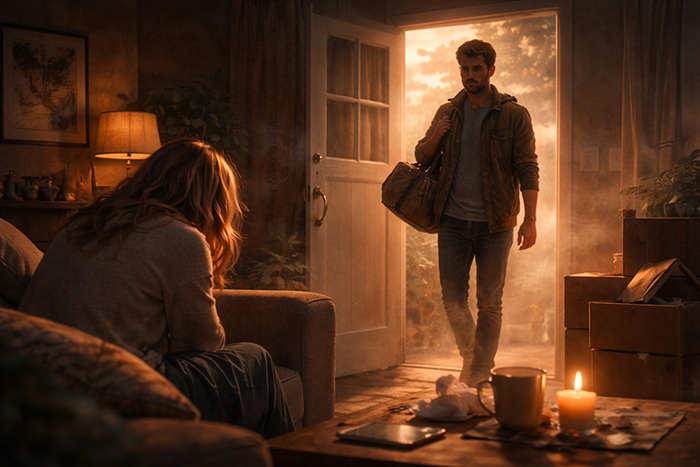
From his perspective, leaving was not a romantic decision. It was a fire exit. Loud alarm, flashing lights, no time to grab your coat.
Did he misjudge what he lost? Possibly. But nobody realises what they’ve lost while sprinting away from a burning building. You don’t stop halfway down the stairs and think, “Wait, was that actually a really nice sofa?” At that moment the brain is doing survival maths: oxygen first, reflection later.
Right now, he is in full containment mode. Structure feels safer than emotion. Work, logistics, and responsibility become the tools that hold the day together. Control is mistaken for calm. Emotional reflection has been postponed indefinitely, like a dentist appointment you promise yourself you’ll book once life “settles down.” There is no grand philosophical reckoning happening here, just forward motion, practical decisions, and an impressive ability to archive feelings under “deal with later.”
Meanwhile, she stands there asking the quiet question that arrives after someone leaves, the one that pretends to be philosophical but is actually deeply human: “Did he get it wrong?”
Translation: “Was I worth staying for?”
Answer: Yes. Absolutely. Without question. Gold-star human. Would recommend.
But here is the part no one prints on inspirational posters: being worth staying for does not automatically mean the relationship itself was survivable. Two people can love each other intensely and still collide emotionally every time life becomes stressful. Love does not automatically arrive with a user manual, nor does it come with a warranty against burnout.
What matters now is not whether he was right or wrong to leave. What matters is what happens after the fire alarm stops ringing. What matters is whether he learns how to stabilise himself, how to take responsibility for his choices, and how to rebuild a life that is not driven purely by escape.
Ironically, that quiet, unglamorous work, self-reflection, accountability, emotional maturity, is the only thing that ever leads to real clarity. Not running faster. Not rewriting history. Not convincing himself the past was simpler than it was.
The grounding truth, delivered without violins, is this: sometimes people leave not because love was missing, but because pain had slowly become the loudest voice in the room. Leaving does not automatically make someone a villain, nor does it make the person left behind unworthy of love.
Clarity, if it ever arrives, always comes late. Usually unannounced. Often when both people have stopped arguing with the fire alarm and quietly realised the building is no longer burning.
© 2026 R.D. Fletcher