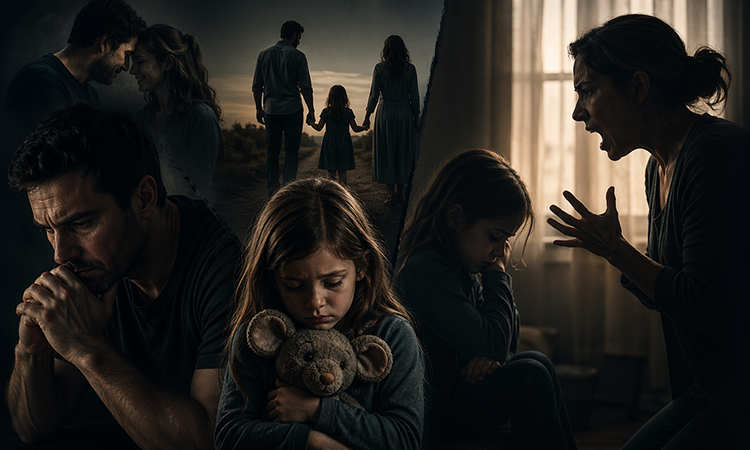
When the Story Began to Change
In the early years of the marriage, life appeared to follow the familiar rhythm many families expect. There were ordinary routines, shared plans for the future, and the belief that raising a child together would strengthen the bond between two people who had once chosen each other with hope and certainty. For a long time, difficulties were interpreted as temporary strains rather than deeper problems.
The moment that quietly marked a turning point came when their child was about six years old. Until then, disagreements between the parents had largely been confined to the private frustrations that many couples experience while balancing work, family, and the daily pressures of life. But something began to shift during that period. Tension started to appear more frequently in the household, often emerging suddenly and unpredictably.
What began as occasional arguments gradually took on a sharper edge. The atmosphere in the home became more strained, and moments that once felt ordinary began to carry a sense of unease. During one particularly troubling period, behavior toward the child crossed a line that the father believed could not be ignored. In moments of anger, the mother began to pinch the child in ways that were meant to punish or control rather than guide.
For the father, the incident was shocking and deeply unsettling. He confronted the situation directly and warned that if it continued, he would involve the authorities. In that moment he believed that the behavior might be a temporary loss of control, a phase brought on by stress, exhaustion, or the emotional pressure that sometimes accompanies parenting. His hope was that a clear boundary would bring the situation to an end and allow the family to return to stability.
For a time, the immediate behavior stopped. The household settled into a fragile calm, and the father tried to convince himself that the episode had been an isolated moment rather than the beginning of something more serious. Like many people in difficult relationships, he chose to believe that the worst had passed.
But the years that followed revealed a different pattern. While the physical incidents did not continue, another form of conflict gradually replaced them. As the child grew older, the atmosphere in the home became increasingly shaped by sharp words, criticism, and emotional tension. What had once appeared as moments of anger slowly evolved into repeated verbal confrontations that affected both the marriage and the child.
The tone of communication within the household changed. Conversations that should have been calm discussions about parenting or daily life often turned into accusations and emotional outbursts. The father began to notice that the emotional environment surrounding the child was becoming more fragile, shaped by words that carried weight long after they were spoken.
For a long time, he continued to hope that these patterns would fade with time. It was easier to believe that stress or circumstances were responsible than to accept that something deeper might be wrong in the foundation of the relationship itself. Many families pass through difficult periods, and he wanted to believe this was one of them.
Yet as the years passed, the contrast between the family’s outward appearance and the private reality inside the home became harder to ignore. What had once been small cracks in the relationship now felt like widening fractures. The father increasingly felt that he was witnessing not isolated arguments but a cycle that repeated itself in different forms.
Looking back, the moment when the child was six now seemed less like a single incident and more like the first visible sign that the marriage was entering a new and more complicated chapter. What had begun with tension and brief flashes of anger slowly evolved into a longer struggle over emotional stability within the household.
For the parents and the child alike, the years that followed would be shaped by that early turning point, one that, at the time, had seemed small enough to overcome but in hindsight marked the beginning of a deeper conflict that neither had fully understood yet.
© 2026 R.D. Fletcher | Extract from A Father’s Silence – Narrative Memoir / Non-Fiction